Factsheet 20: Compound Events
What are compound events?
Compound events are when extreme events occur at the same time, sequentially or across multiple regions at once. Compound events tend to have higher impacts than when events occur on their own. Compound events are characterised in different ways as below:
-
Preconditioned event – an extreme event causes another extreme
event, or amplifies it e.g.
- Heavy rainfall on saturated soil can cause flooding and landslides
-
Multivariate – when multiple hazards occur in the same region at the
same time e.g.
- High rainfall and storm surge can lead to coastal flooding
- Droughts and heatwaves that occur together increase the damage to crops, and are a risk for fires
- High rainfall and wind can lead to damage to infrastructure, and also make repair more difficult
-
Temporally compound – when a sequence of events occurs in a region,
leading to or amplifying impacts e.g.
- Multiple high rainfall events in quick succession increases the risk of flooding
- Multiple frequent fires can be devastating for forests if there isn’t enough time to recover in between
-
Spatially compounding – when connected regions are affected by
extreme events e.g.
- Heatwaves and droughts across many regions can lead to widespread crop failures and severe impacts to the global food system
- Floods occurring across large parts of a transport network can lead to social and economic losses
Australia is vulnerable to compound events. Back-to-back wildfires, extreme rainfall and high winds, have all impacted Australia in recent years leading to damage to infrastructure, loss of homes and lives.
How does climate change impact on compound events?
There are many different types of compound events, all of which may face different climate change impacts. Since the 1990s, compound hot-dry events have been becoming more frequent in Australia. With climate change, this trend is expected to continue in Australia and globally. Compound wet and windy events may get worse in parts of Northern Australia.
Previous research on climate change impacts on compound events in Australia has used global climate models. Global climate models have a coarse resolution of 100 – 200km. This resolution is too coarse to understand local impacts and for informing local adaptation. High-resolution, downscaled projections are needed for this.
Climate change impacts on compound drought-heatwaves
The Queensland Future Climate Science team has analysed the impact of climate change on compound drought heatwave events using our high-resolution (10 km) dynamically downscaled simulations.
We calculated drought using two different metrics - Standardized Precipitation Evapotranspiration Index (SPEI) and Standardized Precipitation Index (SPI), and heatwaves using the Excess Heat Factor, a heatwave metric commonly used in Australia. We analysed the results using storylines and global warming levels. Storylines are a way of addressing uncertainty in climate model projections by looking at what happens under specific type of climate impacts, for example, what are the impacts of a ‘hot-wet’ climate, a ‘hot-dry’ climate, or a ‘cool-dry’ climate? In this case, ‘cool’ doesn’t refer to cooler than the present day, it refers to a climate model that does not warm as much in the future as some of the other models. Global warming levels refer to the amount of warming since the pre-industrial times and are a way of looking at impacts without worrying about the time horizon (i.e., mid vs end of century), or a specific climate change scenario (i.e., low or high emissions).
The current global warming level is approximately 1.2°C above pre-industrial temperatures, while 2°C of global warming is the limit used by the IPCC to represent dangerous climate change. Current policies put the world roughly on track for between 2.5 and 3.5°C of warming. Regardless of how drought is measured, or which storyline we use, compound drought heatwave events get worse in the future. In Northern Australia, at 3°C of warming, the number of events per year is more than double compared to the present day. Even in the wetter futures, and in the futures that don’t show as much warming as the hotter models, the number of compound events increase (Figure 1).
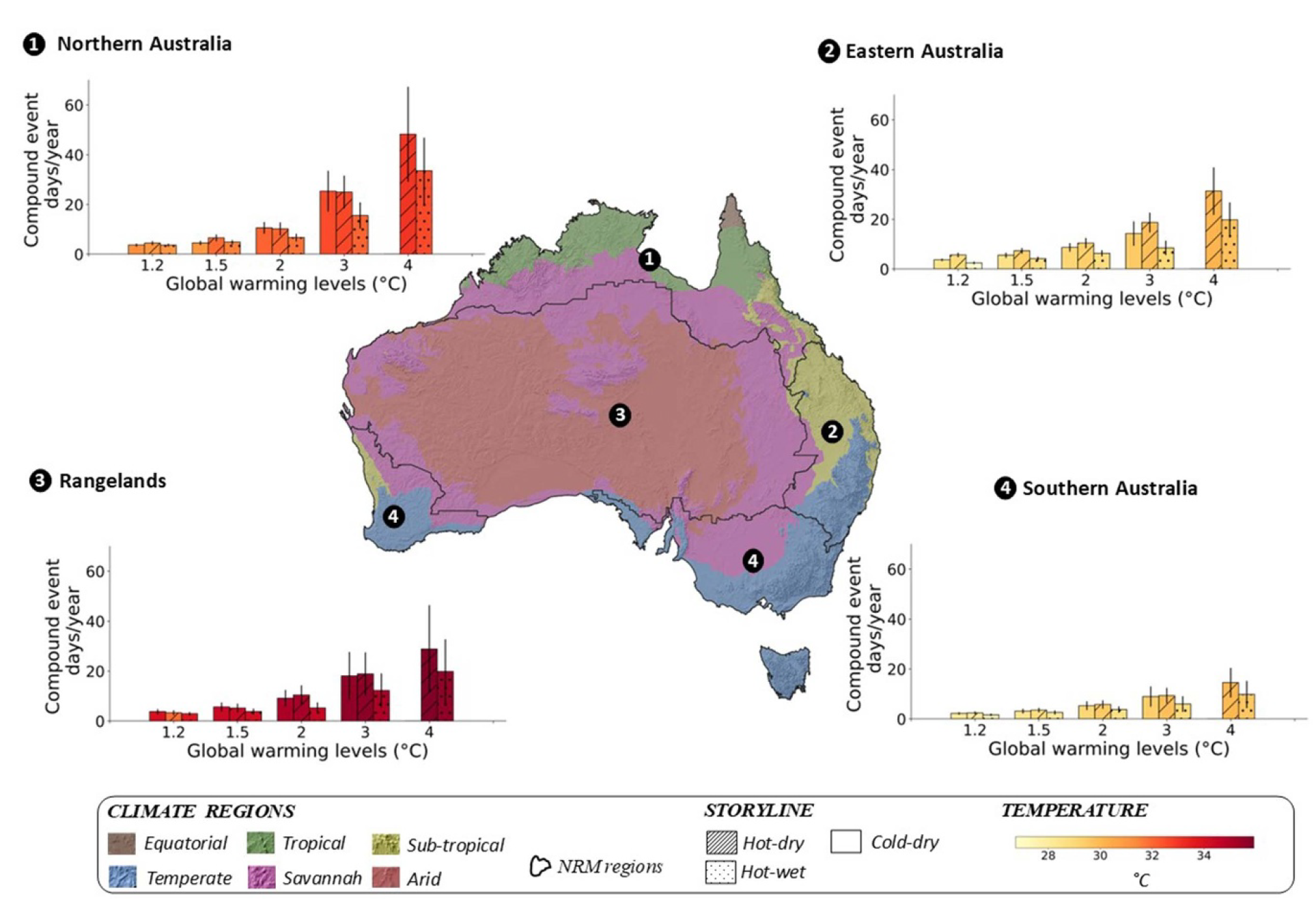
Compound events can be particularly damaging, as people and societies struggle to cope with multiple disasters occurring at the same time. So far, we have only looked in depth at one type of compound event, but other research has shown other types of events may get worse with climate change. Planning and adapting to these increasing risks will be important to reduce their impacts.
References
Chapman, S., Trancoso, R., Syktus, J., Eccles, R., & Toombs, N. 2025. Impacts on compound drought heatwave events in Australia per global warming level. Environmental Research Letters 20(5), 054070. https://doi.org/10.1088/1748-9326/adc8bd
Collins, B. 2021. Frequency of compound hot–dry weather extremes has significantly increased in Australia since 1889. Journal of Agronomy and Crop Science. https://doi.org/10.1111/JAC.12545
King, A., & Poncet, L. , 2024. What we know about last year’s top 10 wild Australian climatic events – from fire and flood combos to cyclone-driven extreme rain. The Conversation. http://theconversation.com/what-we-know-about-last-years-top-10-wild-australian-climatic-events-from-fire-and-flood-combos-to-cyclone-driven-extreme-rain-224614
Ridder, N. N., Pitman, A. J., & Ukkola, A. M. 2022. High impact compound events in Australia. Weather and Climate Extremes, 36, 100457. https://doi.org/10.1016/J.WACE.2022.100457
Ridder, N. N., Ukkola, A. M., Pitman, A. J., & Perkins-Kirkpatrick, S. E. 2022. Increased occurrence of high impact compound events under climate change. Npj Climate and Atmospheric Science, 5(1), Article 1. https://doi.org/10.1038/s41612-021-00224-4
Sauter, C., White, C. J., Fowler, H. J., & Westra, S. 2023. Temporally compounding heatwave–heavy rainfall events in Australia. International Journal of Climatology, 43(2), 1050-1061. https://doi.org/10.1002/joc.7872
Zscheischler, J., Martius, O., Westra, S., Bevacqua, E., Raymond, C., Horton, R. M., Van Den Hurk, B., AghaKouchak, A., Jézéquel, A., Mahecha, M. D., Maraun, D., Ramos, A. M., Ridder, N. N., Thiery, W., & Vignotto, E. 2020. A typology of compound weather and climate events. Nature Reviews Earth & Environment, 1(7), 333-347. https://doi.org/10.1038/s43017-020-0060-z
